


One Vendor or Several? How to Structure a DG Set Project
A buyer installing standby power has to decide how to contract it before deciding who to contract with. This is a guide to that decision, written at category level rather than as a case for any particular supplier.
A turnkey DG project means one contractor carries supply, installation, acoustic treatment, statutory approvals and commissioning under a single contract, often with maintenance contracted to the same party afterwards. A split contract means the buyer procures those scopes separately and coordinates them.
Both work. Split contracts are common and often sensible. What decides between them is not price, it is whether the buyer has someone who can own the interfaces between the scopes, because that is where DG projects actually fail.
In short. A DG installation is five scopes that have to fit together: the set, the acoustic treatment, the balance of plant, the statutory approvals and the maintenance. A turnkey contract puts all five under one accountable party. A split contract distributes them and leaves the buyer holding the joins. The question worth asking is not which is cheaper but who owns the gap between the genset supplier's drawing and the electrical contractor's execution, because on a split contract the answer is often nobody.
The Five Scopes
Every DG installation contains the same five, regardless of how they are contracted.
- Supply. The generator set, the acoustic enclosure, and the AMF, ATS, synchronising and LT panels.
- Acoustic treatment. Enclosure fitment, or wall and ceiling treatment of the DG room where the set cannot be canopied, plus treated ventilation paths and exhaust silencing.
- Balance of plant. Exhaust and stack, fuel system, earthing, cabling, structural steel. On most projects this is the larger share of both cost and risk.
- Statutory approvals. Electrical Inspectorate approval where the installation exceeds the state-notified capacity, pollution control board consents, and PESO licensing where bulk diesel storage exceeds the exemption threshold.
- Maintenance. Preventive servicing to the OEM schedule, and breakdown cover.
A turnkey contract covers all five. A split contract typically procures supply from one party, balance of plant from an electrical contractor, acoustics from a specialist, approvals through a liaison agent, and maintenance separately again.
Where Split Contracts Actually Fail
Not on any single scope. Each vendor usually does its own work competently. Failures cluster at five specific interfaces.
-
The ventilation opening
The DG room needs a free area for combustion and cooling air. The acoustic treatment needs that air to travel a long, lined path. The civil contractor builds the opening to the architect's drawing.
Reduce the opening to control noise and the engine derates. Enlarge it and the acoustic target is missed. Get it wrong and the choice is between running a set below its rating and rebuilding a wall.
On a split contract, the genset supplier specified an airflow requirement, the acoustic vendor specified a path, and the civil contractor built an opening. Nobody reconciled the three.
-
The certified figure and the boundary reading
A set certified at 75 dB(A) at 1 metre is not a set that will meet a residential boundary limit of 45 dB(A) Leq at night. Under CPCB's System and Procedure, the obligation to bring noise outside the premises within ambient limits sits with the user, discharged through siting and control measures.
Worse, the scope of ISO 8528-10 excludes exhaust and cooling noise where those are ducted to a remote point. So the certified figure does not account for what leaves the stack at roof level.
The genset supplier has delivered a compliant set. The acoustic vendor has delivered a compliant enclosure. The complaint is still the owner's.
-
Approved drawings and site reality
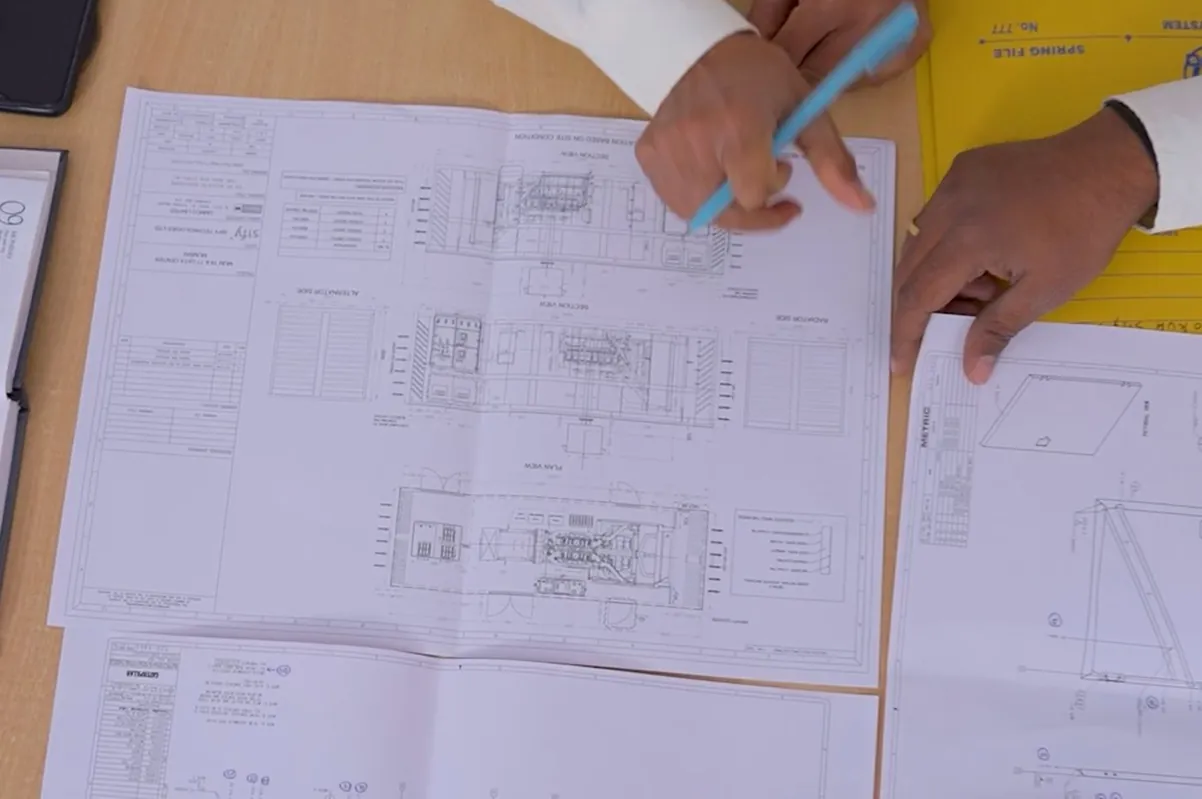
A DG project generates up to eight drawing sets that go for approval: layout, general arrangement, foundation, exhaust, fuel, earthing, cable routing and bus duct where applicable. Each depends on the others. The foundation depends on the set. The cable routing depends on the panel positions. The exhaust depends on the structure.
Where one design team produces all of them against one survey, the dependencies are resolved on paper. Where four vendors each design to their own scope, they are resolved on site, which is more expensive and slower.
-
Statutory scope
Electrical Inspectorate approval requires drawings, test reports and an inspection. Pollution control board consents specify a minimum chimney height per set and require acoustic enclosures as the control measure. PESO licensing applies where the bulk diesel tank exceeds PESO's published exemption threshold of 1,000 litres in a tank.
These are not sequential, and they reference each other. The consent order specifies the chimney height that the structural design has to be built to. Under the CEA Safety Regulations 2023, earthing systems must be tested to ensure effective bonding before apparatus is energised, and those test reports form part of what the Inspectorate expects.
On a split contract, approvals usually fall to the buyer or a liaison agent who did none of the work being approved.
-
Warranty and the handover set
When a set underperforms, the causes are distributed. Restricted ventilation, exhaust backpressure above the engine manufacturer's limit, incorrect earthing, poor fuel line installation. Each sits with a different vendor, and each vendor can point at another.
The practical symptom is documentation. On a split contract the handover set gets assembled at the end from several parties, and it is routinely incomplete. Missing test certificates matter later, when the Inspectorate returns for periodic inspection or when a warranty claim is made.
When Each Structure Makes Sense
A split contract works when the buyer has an in-house projects team or an appointed PMC with DG experience, existing vendor relationships worth preserving, an unusual technical requirement no single contractor covers, or a procurement policy requiring separate tendering. Large industrial buyers with permanent engineering staff often run split contracts well.
A turnkey contract works when the buyer's team is facilities rather than projects, the site has constraints that will need decisions during execution, the programme is tied to a building handover date, or the installation is noise-sensitive. Most commercial, institutional and hospitality installations sit here.
The honest framing: a split contract transfers coordination risk to the buyer in exchange for procurement control. That is a reasonable trade when the buyer can carry the risk, and a poor one when they cannot.
What to Ask, Either Way
If you are contracting turnkey, ask which scopes are genuinely in house and which are subcontracted, since the accountability argument weakens with each layer. Ask who the named project manager is and what authority they hold on site. Ask what the handover document set contains, in writing. Ask whether statutory approvals are in scope or coordinated, since those are different commitments.
If you are contracting split, appoint one party to own the interfaces before work starts, and write that into their scope. Reconcile the ventilation opening across the genset, acoustic and civil scopes at drawing stage. Decide who holds PESO licensing. Agree the handover document list up front and make final payment contingent on it.
Frequently Asked Questions
Who is responsible if the installation fails inspection?
On a turnkey contract, the contractor, since they produced the drawings, executed the work and submitted for approval. On a split contract it depends on why it failed, and that is the problem. A failure caused by earthing sits with the electrical contractor, one caused by clearance around the switchboard may sit with the civil contractor or the designer, and one caused by chimney height sits between the structural and consent scopes. Establish in advance who is accountable for approval as an outcome, not just for their own workmanship.
Can I buy the generator and tender the installation separately?
Yes, and many buyers do. The risk is not the split itself but the specification gap. The genset supplier specifies airflow, backpressure limits and foundation loading. Those requirements have to reach the installation tender in enough detail to be priced and built to. Where the supply order is placed first and the installation tendered later against a generic scope, the installer prices what is written rather than what the set needs.
Does turnkey cost more?
On the contract value, often yes, since coordination is priced in rather than absorbed by the buyer. On total cost, it depends entirely on whether the buyer would have absorbed that coordination well. The costs that do not appear in either tender are programme delay, derating from a badly sized ventilation opening, and rework after a boundary noise complaint. Those are the costs a split contract exposes the buyer to and a turnkey contract prices against.
What if I already have a preferred electrical contractor?
That is a common and workable position. Scope the turnkey contractor for supply, acoustics, exhaust, fuel and approvals, and carve out the electrical works, but define the interface explicitly. Name who terminates at the panel, who tests and issues the megger and earthing reports, and who is accountable for the installation passing inspection. A carve-out with a defined interface behaves like a turnkey contract. A carve-out without one behaves like a split contract with extra steps.
Sources
Central Pollution Control Board, System and Procedure for Compliance to Emission and Noise Limits for Gensets, clause 4.3. Ministry of Environment and Forests, GSR 371(E). Central Electricity Authority (Measures relating to Safety and Electric Supply) Regulations, 2023. Petroleum and Explosives Safety Organisation, published FAQs on the Petroleum Rules 2002. ISO 8528-10 published scope. Karnataka State Pollution Control Board Consent for Operation orders.