


Acoustic Treatment and Sound Attenuation for Diesel Generators
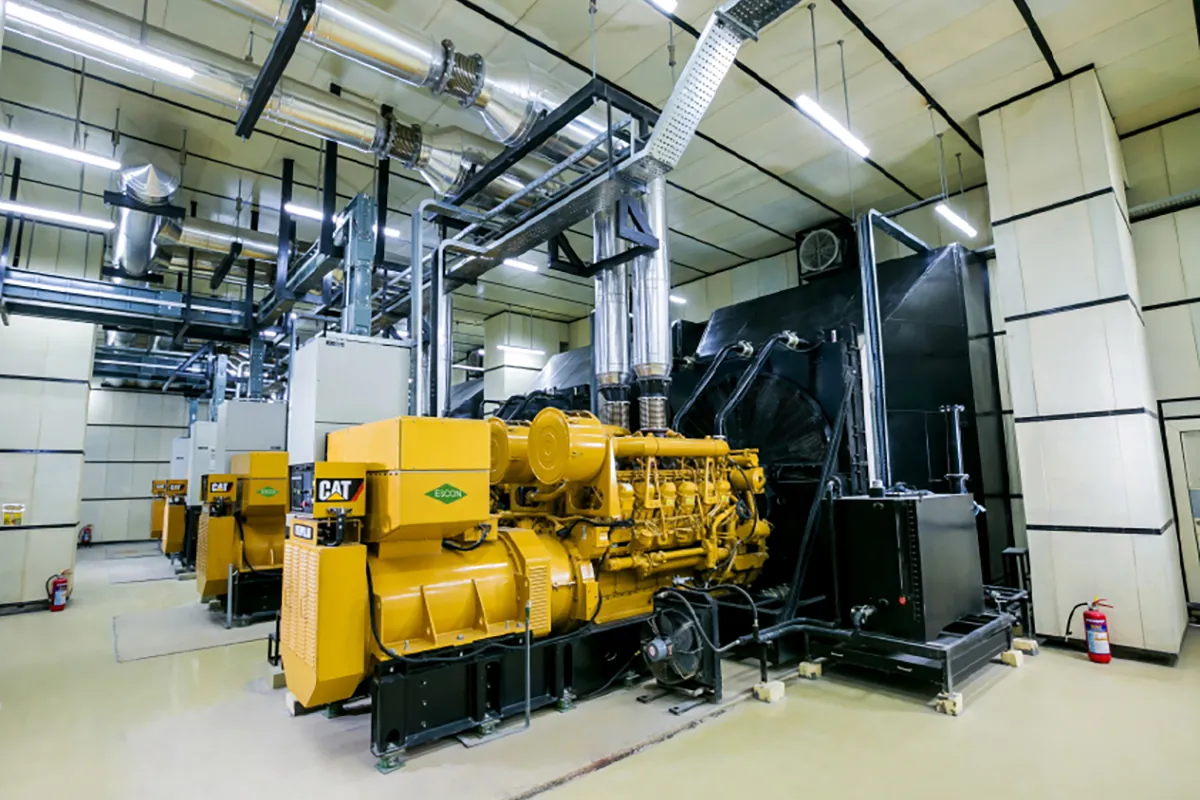
A guide to what Indian law requires, how enclosures and room treatment achieve it, and where noise compliance sits in the installation programme.
Diesel generator noise in India is governed by two separate requirements that sit with two different parties. The manufacturer must supply a set that meets 75 dB(A) at 1 metre. The user must ensure noise outside the premises stays within the ambient limit for the zone the site sits in. A set that fully complies at the factory can still breach the limit at a residential boundary, and the liability for that sits with the owner.
Escon Gensets manufactures acoustic enclosures from 10 kVA to 3000 kVA for any engine make, and executes acoustic room treatment where a set cannot be canopied. Both are delivered pan-India.
In short. Under GSR 371(E), new diesel sets up to 1000 kVA are limited to 75 dB(A) at 1 metre from the enclosure surface. Where a set is not covered by that provision, CPCB requires the enclosure or the room treatment to be designed for a minimum 25 dB(A) insertion loss, or to meet ambient noise standards, whichever is higher. Ambient limits run from 75 dB(A) Leq by day in industrial areas down to 40 dB(A) Leq at night in silence zones. Meeting them is the user's obligation, discharged through siting and control measures.
What the Law Requires
The manufacturing limit
Under GSR 371(E), notified on 17 May 2002 under the Environment (Protection) Act 1986 and in force from 1 January 2005, the maximum permissible sound pressure level for new diesel generator sets with rated capacity up to 1000 kVA is 75 dB(A) measured at 1 metre from the enclosure surface. Such sets are to be provided with an integral acoustic enclosure at the manufacturing stage.
This obligation sits with the manufacturer. It is a type-level requirement, not a site measurement.
The site obligation
Where a genset is not covered by the integral enclosure provision, CPCB's System and Procedure requires that noise be controlled by an acoustic enclosure or by treating the room acoustically at the user's end. The enclosure or the treatment shall be designed for a minimum of 25 dB(A) insertion loss, or for complying with ambient noise standards, whichever is on the higher side.
The exhaust muffler carries a separate requirement of minimum 25 dB(A) insertion loss.
Ambient limits, by zone
Ambient noise limits are set under the Noise Pollution (Regulation and Control) Rules, 2000 and applied by State Pollution Control Boards through consent conditions. They are expressed as dB(A) Leq, an energy mean over a period, rather than as instantaneous peaks.
| Zone | Day, 6 am to 10 pm | Night, 10 pm to 6 am |
|---|---|---|
| Industrial | 75 dB(A) Leq | 70 dB(A) Leq |
| Commercial | 65 dB(A) Leq | 55 dB(A) Leq |
| Residential | 55 dB(A) Leq | 45 dB(A) Leq |
| Silence zone | 50 dB(A) Leq | 40 dB(A) Leq |
These are the figures written into Consent for Operation orders, alongside a minimum chimney height for each DG set and a requirement for acoustic enclosures as the noise control measure.
Who carries the risk
CPCB places the obligation to bring noise levels outside the premises within ambient requirements on the user, through proper siting and control measures. It also requires that installation comply strictly with the genset manufacturer's recommendation. Enforcement sits with the State Pollution Control Boards.
This is the single most consequential point in this guide. Compare the two numbers. A compliant set produces 75 dB(A) at 1 metre. A residential zone permits 45 dB(A) Leq at night at the boundary. The gap between those figures is closed by siting, enclosure specification and room design, and it is the owner who must close it.
How Noise Is Measured and Certified
Type certification
Noise conformance to CPCB norms is assessed by the same agencies that handle emissions certification. The Automotive Research Association of India tests diesel generator sets up to 1000 kVA, and petrol and kerosene sets up to 19 kW, at its NVH laboratory. Sound power level is measured as per ISO 3744 and ISO 8528-10. Temperature and exhaust backpressure are measured alongside.
ISO 8528-10 is the noise test code for engine-driven generating sets, using the enveloping surface method, and is adopted in India by the Bureau of Indian Standards as IS/ISO 8528-10. It classifies results by accuracy grade: grade 2 is the engineering method under ISO 3744, grade 3 the survey method under ISO 3746.
Sound power and sound pressure are not the same quantity
This trips up buyers comparing datasheets.
Sound power level is a property of the machine. It does not vary with distance and is what type testing measures. Sound pressure level is what a meter reads at a given point, and it falls as you move away from the source. The 75 dB(A) limit is a sound pressure level at a stated distance of 1 metre. Ambient limits are sound pressure levels at the boundary.
A supplier quoting a sound power figure and a supplier quoting a sound pressure figure are not quoting comparable numbers. Ask which one, and at what distance.
What the certified figure does not include
The scope of ISO 8528-10 excludes the noise contribution of exhaust and cooling systems where these are ducted away to a remote point. On a site installation with a stack running to roof level, the certified figure for the set does not account for what comes out of the discharge point.
That is precisely why the exhaust carries a separate silencer requirement, and why exhaust treatment is a distinct line in the acoustic scope rather than something the enclosure handles.
Measuring insertion loss on site
Insertion loss is the reduction in sound level achieved by adding an enclosure, room treatment or muffler, expressed in dB(A).
CPCB specifies the method. Insertion loss may be measured at several points 0.5 metre from the acoustic enclosure or room and then averaged. Where actual ambient noise is high enough to mask the measurement, performance may be checked at night, between 10.00 pm and 6.00 am.
Two practical consequences follow. A single spot reading is not a measurement, so a supplier quoting one figure from one point is not demonstrating compliance. And a daytime measurement on a noisy industrial site can understate the enclosure's contribution, which is why the night window exists.
Enclosure Types, and When Each Applies
Escon manufactures three enclosure architectures. The choice is driven by set size, site access and who is fitting the set, not by price alone.
Integrated enclosures
Fully customisable to generator manufacturer specifications, with integrated fuel systems, exhaust connections, base frames and silencers. These are bottom-lifting units into which the generator is fitted directly.
Suited to OEM fitment and to sites where a complete canopied set can be delivered and lifted into position.
Drop-down enclosures
Five-sided, self-supporting acoustic structures assembled on site and capped onto the DG set. Fully modular.
Suited to sites where access will not permit delivery of a complete canopied set. This is the option that solves the most common site constraint, which is a DG room or basement that the finished unit cannot physically reach.
Containerised enclosures
Top-lifting, fully welded units built on ISO shipping container principles and supplied as a complete package with the DG set.
Suited to large sets, transportable installations and applications requiring weatherproofing and structural robustness.
Barrier Materials and How Attenuation Works
Four mechanisms do the work. An enclosure that neglects any one of them underperforms regardless of its material specification.
Barrier mass
Sound transmission through a panel falls as the mass per unit area of that panel rises. This is why enclosure sheet gauge matters and why a lighter canopy with identical internal lining performs worse. Mass is the mechanism that stops sound getting out. Absorption alone will not do it.
Absorption
Internal lining converts sound energy to heat rather than reflecting it back inside the enclosure. Genset enclosures use fire retardant acoustic and insulation material, typically polyurethane foam or rockwool, per Mahindra Powerol's published enclosure specification.
Two properties matter and they are separate. Acoustic absorption determines how much energy the lining removes. Fire retardancy is a safety requirement given the fuel, hot exhaust surfaces and electrical equipment inside the enclosure. A material that performs well acoustically and is not fire retardant does not belong in a genset enclosure.
Rockwool is a mineral wool with inherent fire resistance and good performance across the mid and high frequency range. Polyurethane acoustic foam is lighter and easier to profile, and must be specified in a fire retardant grade. Selection is usually driven by the operating temperature at the lining position and by the frequency content of the particular engine.
Damping and sealing
Panel resonance and gaps leak sound. Doors, cable entries, fuel line penetrations and panel joints are all sound paths, and a well-lined enclosure with poorly sealed penetrations will miss its target regardless of lining specification. Sealing detail is the difference between a design figure and a measured one.
Airflow path treatment
Air must enter and leave, and every opening is a sound path. Attenuation is achieved by lengthening and lining that path, typically through baffled inlets and outlets, rather than by restricting it. This is covered in the next section, Ventilation and Deration, because it is also where the most expensive mistakes are made.
Exhaust treatment
The exhaust is a separate system with its own requirement. A residential silencer is specified where the discharge point sits near occupied property, and the muffler carries its own minimum 25 dB(A) insertion loss requirement under CPCB's System and Procedure. Exhaust silencer insertion loss is measured under ISO 15619.
Ventilation and Deration, the Point Buyers Get Wrong
An acoustically sealed room that cannot breathe will derate the engine.
Diesel gensets need airflow for combustion and for radiator cooling. Restricting intake or discharge to reduce noise raises the operating temperature and reduces the usable output of the set. The result is an installation that is quiet and cannot deliver its nameplate rating.
The correct approach is to lengthen and line the airflow path rather than narrow it. Baffled inlet and outlet routes attenuate sound while maintaining the free area the engine requires.
The same tradeoff applies to the exhaust. A higher attenuation silencer raises exhaust backpressure, and engine manufacturers specify a maximum allowable backpressure. Exceed it and the engine loses efficiency and runs hotter. This is why backpressure is measured alongside noise during type testing, and why silencer selection is an engine decision as much as an acoustic one.
Escon engineers enclosures to deliver the target sound level with zero deration of the generator set. That is an engineering requirement stated at design stage, not an outcome measured afterwards, and it is the reason enclosure design and ventilation design cannot be separated.
When Room Treatment Replaces an Enclosure
Some installations cannot use an enclosure. Multiple sets in a single plant room, sets above a certain rating, and sets already installed open are the common cases.
In those installations the room itself becomes the enclosure. Escon's room treatment scope covers:
- Wall and ceiling panelling, applying the same barrier and absorption principles at room scale.
- Parallel baffles at the air inlet and outlet, attenuating sound along the ventilation path without restricting free area.
- Room design, meaning the layout, the position of openings and the routing of the ventilation path.
The engineering is the same. The difference is scale and the fact that a room is usually a fixed structure, which is why acoustic room treatment has to be designed alongside the DG room rather than added to a finished one.
Where Acoustic Scope Sits in the Installation Programme
Acoustic treatment is a design-stage decision that is expensive to revisit. Three points in the programme matter.
At site survey. Access determines enclosure type. A site that cannot receive a complete canopied set needs a drop-down enclosure, and discovering that at delivery rather than at survey costs weeks.
At drawing approval. DG room ventilation openings appear on the approved layout. They are frequently reduced by someone who does not know what they are for. Once the room is built to a reduced opening, the choice is between derating the set and rebuilding the wall.
Before the boundary is measured. Ambient compliance depends on siting, zone and room construction. All three are fixed long before anyone takes a reading.
The practical implication is that acoustic scope belongs inside the turnkey contract rather than alongside it. Where the genset, the room and the acoustic treatment come from different vendors, the ventilation opening is exactly the interface that gets missed.
Compliance Checklist
Work through this before commissioning.
- Confirm the zone the premises sits in, and therefore the applicable ambient limit for day and night.
- Confirm the set meets 75 dB(A) at 1 metre and carries an integral acoustic enclosure, where it falls under GSR 371(E).
- Confirm the enclosure or room treatment is designed for at least 25 dB(A) insertion loss, or for the ambient standard, whichever is higher.
- Confirm the exhaust muffler carries a minimum 25 dB(A) insertion loss.
- Check the ventilation free area against the set's requirement, not against the drawing alone.
- Confirm the chimney height specified in the pollution control board consent order has been built.
- Measure insertion loss properly, at several points 0.5 metre from the enclosure or room, averaged, and at night where ambient noise would mask the reading.
- Retain the measurement record. Consent conditions are enforced on inspection, and a documented reading is the defence.
Frequently Asked Questions
Is a sound power rating the same as a sound pressure rating?
No, and comparing them directly is a common specification error. Sound power level is a property of the machine and does not vary with distance. Sound pressure level is what a meter reads at a given point and falls with distance. The 75 dB(A) statutory limit is a sound pressure level at 1 metre. Type testing measures sound power level per ISO 3744 and ISO 8528-10. When comparing supplier datasheets, confirm which quantity is quoted and at what distance.
Does the certified noise figure cover my exhaust?
Not where the exhaust is ducted away to a remote discharge point. The scope of ISO 8528-10 excludes the noise contribution of exhaust and cooling systems ducted to a remote site, so a set's certified figure does not account for what leaves a stack at roof level. Exhaust noise is controlled separately, through a silencer carrying its own minimum 25 dB(A) insertion loss requirement.
What is insertion loss and why 25 dB(A)?
Insertion loss is the reduction in sound level achieved by adding an enclosure, room treatment or muffler. CPCB requires enclosures and room treatment to be designed for a minimum of 25 dB(A), or for the applicable ambient standard, whichever is higher. It is a design requirement, so the specification has to be established before manufacture rather than tested for afterwards.
Can acoustic treatment reduce my generator's output?
It can, if the ventilation path is restricted rather than treated. Diesel engines need airflow for combustion and cooling, and narrowing the intake or discharge to reduce noise raises operating temperature and derates the set. Properly designed treatment lengthens and lines the airflow path using baffled inlets and outlets instead of restricting it.
Should I use an enclosure or treat the room?
An enclosure where the set can practically be canopied, room treatment where it cannot. Multiple sets in one plant room, higher-rated sets and sets already installed open usually call for room treatment. The engineering principles are identical, the difference is scale.
Can an existing installation be retrofitted?
Usually, though the options narrow. Room treatment can be applied to a built DG room, and enclosures can be added to open sets. What cannot easily be changed after the fact is the ventilation opening and the siting of the set, which is why the retrofit result is often more expensive and less effective than designing for the target at the start.
Sources
- Ministry of Environment and Forests, GSR 371(E) dated 17 May 2002, as recited in MoEF correspondence on noise and emission limits for generator sets.
- Central Pollution Control Board, System and Procedure for Compliance to Emission and Noise Limits for Gensets, 2016, clause 4.3.
- Noise Pollution (Regulation and Control) Rules, 2000, as applied in Karnataka State Pollution Control Board Consent for Operation orders.
- Automotive Research Association of India, genset certification, noise testing at the NVH Laboratory.
- ISO 8528-10, adopted in India as IS/ISO 8528-10 by the Bureau of Indian Standards.
- ISO 3744 and ISO 3746.
- ISO 15619 for exhaust silencer insertion loss.
- Mahindra Powerol published enclosure specifications.